

What You Will Learn
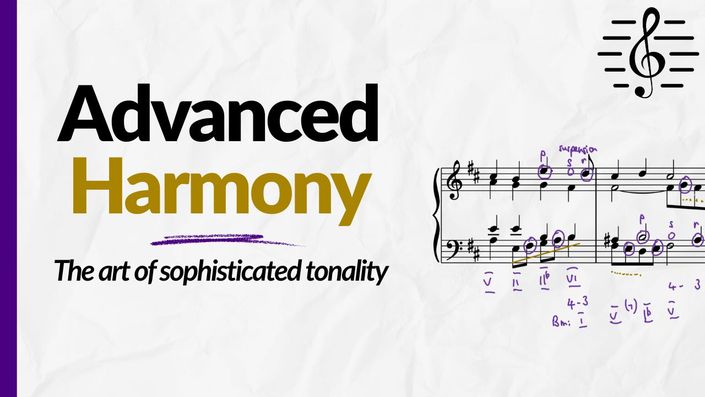
Achieve expert-level command of tonal and chromatic harmony with the Advanced Harmony course.
Deepen your understanding of Western tonal practice and discover how to write, analyse, and think harmonically at a professional level. Designed to follow on directly from our Basic Harmony course, this comprehensive course explores the expressive, chromatic, and modulatory tools that shaped music from the Baroque through to the Romantic period — giving you the fluency to create and understand sophisticated harmonic writing. Whether you’re preparing for exams, studying at university level, or composing and arranging your own music, this course offers the clarity, structure, and insight you need to master advanced harmony. During the Advanced Harmony course we'll cover...
- Expressive Dissonance and Ornamentation - What gives appoggiaturas and suspensions their expressive power? How do we prepare and resolve dissonances with control and style? How can non-chord tones add colour without breaking harmonic coherence?
- Advanced Chord Function - What roles do inversions play in shaping harmonic flow? When and why do we use cadential, passing, or auxiliary 6/4 chords? How can we use figured bass and Roman Numeral notation to think harmonically?
- Chromatic Harmony and Modulation - How do secondary dominants and diminished chords enrich tonal movement? What makes a modulation smooth, surprising, or dramatic? How can chromatic approaches expand the expressive range of a piece?
- Harmonic Rhythm and Multi-Part Writing - How does harmonic rhythm influence phrasing and tension? What are the principles of writing fluently in two, three, or more parts? How do voice-leading decisions affect the listener’s sense of direction and balance?
- Analytical Insight and Advanced Application - How do we recognise complex harmonic patterns in great music? What can we learn from the harmonic craft of composers like Bach and Chopin? How do we translate advanced harmonic understanding into expressive composition and analysis?
The videos and classes delve into areas not covered by the rest of the online music instructors, focusing on theory and quality instead of how to become rich and famous. If your goal is to improve your music and musicianship, I'd be hard pressed to recommend anything better.
- Jim

Who Is This Course For?
Musicians committed to reaching professional-level harmonic fluency.
If you’ve ever wanted to think, hear, and write like a professional composer — to understand the real mechanics behind great music — this is the course that takes you there. Advanced Harmony is for dedicated musicians, composers, and students who already understand the basics but are ready to move into expert territory — where harmony becomes expressive, fluid, and alive. Whether you’re preparing for high-level music exams, studying at university, composing original works, or simply striving to understand what makes the music you love so powerful, this course gives you the tools, insights, and professional techniques to do it with confidence. You’ll learn how expert composers think — how they structure progressions, shape modulations, and use dissonance with intent. This is not just a continuation of theory — it’s a transformation in how you understand and use harmony. If you’re serious about writing, analysing, or performing music at a truly advanced level, this course is your path to becoming fluent, expressive, and fearless in harmony.
Do any of these sound familiar?
"I understand basic harmony, but I struggle to make my writing sound rich, expressive, and stylistically convincing..." "I can analyse music on the surface, but I want to think like a composer and understand the deeper structure behind every chord and modulation..." "I know how to harmonise simple melodies, but I want to write with fluency and sophistication..." "I can follow harmonic rules, but I want to learn how to bend them creatively while staying stylistically authentic..." "I want to write, arrange, and analyse music that sounds professional, expressive, and polished, but I need the tools and guidance to reach that level..."
↓
At last!!! You are the best teacher I have experienced. I had a great deal of difficulties, understanding, but your way of teaching is like guiding me to walk step by step without stumbling on my face. Your way showed me that I can and am able to understand music, in spite of my fear. Thank you very much for your attribution, to those frightened students. Bless you.
- Neomi

By the end of the Advanced Harmony course you'll be able to…

Write and harmonise melodies confidently using appropriate chords, inversions, and expressive non-chord tones
Construct, identify, and resolve a wide range of harmonic devices — suspensions, appoggiaturas, secondary dominants, and more
Apply modulation techniques using pivot chords, pivot notes, and chromatic progressions
Analyse complex harmonic writing from the Baroque, Classical, and Romantic periods with insight and accuracy
Compose using advanced chromatic harmony, including diminished sevenths, Neapolitan chords, and augmented sixths
Demonstrate a fluent understanding of Roman Numerals, Leadsheet notation, Figured Bass, and harmonic rhythm across multiple parts
You have taught me an incredible amount. You are the teacher that actually sparked my interest in learning how to compose orchestral/"classical" music. And that is because you make it so easily understandable. Also you take time to refresh fundamental steps in order for the videos to make sense, not assuming the watcher already knows them. Thank you for all you have done. Words can not describe how big of an impact you are on so many peoples lives. From the people learning directly from your videos, to the people those people go on to teach, and furthermore to the listeners listening to the music created as a result.
- Jarod

Course Information
What's Included with the Advanced Harmony Course?
Professional Teaching
You’ll receive expert guidance that makes complex harmony clear, logical, and easy to apply in real music.
Practical Exercises
Every concept is backed by practical examples and exercises that help you hear, see, and understand harmony in action.
Ask Questions
Below each video you are able to post comments and ask questions should you have any in regards to the course topics covered.
Easy to Follow Structure
The course is divided into multiple stages, breaking down each part separately before putting it all together.
Complete at Your Own Pace
You can easily fit the course around your regular commitments, completing it at your own pace and in your own time.
Anywhere Access
Your course never expires. Learn when and where you choose! Computer or mobile. Just get comfortable and dive in!
↓
Your Instructor

Hi, I’m Gareth and I'm passionate about developing ‘the all round musician’.
Over 35 years of music examining with ABRSM, work with the BBC on Radio and TV, experience on the international concert platform, as a published composer and arranger, have brought rich resources to the 40 years of teaching in which I've engaged.
Scholarships at The Royal College of Music, Oxford University and St. Paul’s Cathedral gave me fantastic opportunities to learn from the best musicians, scholars and teachers. Working as Director of Music at Queen Elizabeth Grammar School then provided a wonderful opportunity to develop my teaching skills.
Teaching individuals and groups of all ages, and at all stages of development have refined a teaching approach that I hope is fun and engaging, and focused on explaining things clearly and logically. And that is what these courses are all about - understanding the basic principles with clarity, then going deeper, applying them to your musical life and liberating yourself as a musician.
It’s a rich and amazing journey, and I can’t wait for you to join me today!
Course Curriculum
-
StartLesson 1 - Appoggiaturas (14:43)
-
StartLesson 2 - Suspensions (42:56)
-
StartLesson 3 - Using Second Inversion Chords (25:05)
-
StartLesson 4 - Extending Figured Bass Knowledge (20:27)
-
StartLesson 5 - Harmonising the Same Melody in Different Ways (26:04)
-
StartLesson 6 - Harmonic Rhythm (39:39)
-
StartLesson 7 - Harmonising an Ascending Major Scale (18:50)
-
StartLesson 8 - Harmonising a Descending Major Scale (14:10)
-
StartLesson 9 - Harmonising an Ascending Harmonic Minor Scale (14:39)
-
StartLesson 10 - Harmonising a Descending Harmonic Minor Scale (12:18)
-
StartLesson 11 - Harmonising an Ascending Melodic Minor Scale (18:05)
-
StartLesson 12 - Harmonising a Descending Melodic Minor Scales (24:48)
-
StartLesson 13 - Modulating up a Semitone (9:51)
-
StartLesson 14 - Rule of the Octave (23:50)
-
StartLesson 15 - Seventh Chords (11:41)
-
StartLesson 16 - Resolution of 7th Chords (19:18)
-
StartLesson 17 - Chain of 7ths (14:50)
-
StartLesson 18 - Writing Sequences (12:24)
-
StartLesson 19 - Using VII and Other Diminished Chords (15:48)
-
PreviewLesson 20 - Using Chord III in Minor Keys (11:28)
-
PreviewLesson 21 - Writing in Two Parts (18:11)
-
StartLesson 22 - Writing in Three Parts (24:59)
-
StartLesson 23 - Writing in Five or More Parts (29:35)
-
StartLesson 24 - Modulation using Pivot Chords (24:48)
-
StartLesson 25 - Modulation using Pivot Notes (16:46)
-
StartLesson 26 - Modulation Without Using Pivots (7:47)
-
StartLesson 27 - Secondary Dominants (23:53)
-
StartLesson 28 - Diminished 7ths (30:19)
-
StartLesson 29 - Half-Diminished 7ths (7:16)
-
StartLesson 30 - The Neapolitan Chord (15:03)
-
StartLesson 31 - Augmented 6th Chords (20:44)
-
StartLesson 32 - Tierce de Picardie (4:42)
-
StartLesson 33 - Other Borrowed Chords (14:49)
-
StartLesson 34 - Further Extended Chords (15:48)
-
StartLesson 35 - Pedal Points (9:03)
-
StartLesson 36 - Analysis of a Bach Chorale Extract (41:05)
-
StartLesson 37 - Analysis of a Chopin Prelude Extract (31:28)
-
StartAppoggiaturas
-
StartSuspensions
-
StartUsing Second Inversion Chords
-
StartExtending Figured Bass Knowledge
-
StartHarmonising the Same Melody in Different Ways
-
StartHarmonic Rhythm
-
StartHarmonising an Ascending Major Scale
-
StartHarmonising an Descending Major Scale
-
StartHarmonising an Ascending Harmonic Minor Scale
-
StartHarmonising a Descending Harmonic Minor Scale
-
StartHarmonising an Ascending Melodic Minor Scale
-
StartHarmonising a Descending Melodic Minor Scale
-
StartModulating up a Semitone
-
StartRule of the Octave
-
StartSeventh Chords
-
StartResolution of 7th Chords
-
StartChain of 7ths
-
StartWriting Sequences
-
StartUsing VII and Other Diminished Chords
-
PreviewUsing Chord III in Minor Keys
-
PreviewWriting in Two Parts
-
StartWriting in Three Parts
-
StartWriting in Five or More Parts
-
StartModulation using Pivot Chords
-
StartModulation using Pivot Notes
-
StartModulation Without Using Pivots
-
StartSecondary Dominants
-
StartDiminished 7ths
-
StartHalf-Diminished 7ths
-
StartThe Neapolitan Chord
-
StartAugmented 6th Chords
-
StartTierce de Picardie
-
StartOther Borrowed Chords
-
StartFurther Extended Chords
-
StartPedal Points
-
StartHarmonic Analysis
Frequently Asked Questions
A Letter from Gareth Green
MA (Oxon), MA (Leeds), FRCO(CHM), FLCM, ARCM
During the past half century many students have come my way asking for help with harmony. Some have been performers who have simply struggled to understand what was going on in the harmony of the music they were playing. Some have been composers who have desperately wanted to extend their harmonic vocabulary. Some have been frustrated that they could hear harmony in their head but could not write it down. Others have wanted to be successful in harmony exams and have felt dumbfounded by the text books they had encountered.
This course is a crystallisation of these many and rich teaching experiences, through which I have discovered the need to be clear and logical about the learning of harmony and the need to simplify concepts that are often presented in a more complicated way than they need to be.
For me, harmony has become a lifelong passion and a central part of my playing, improvising, composition and teaching for well over 40 years.
That’s why we created this comprehensive online course in harmony here at Music Matters. It brings together everything I’ve learned — not only as a performer, composer and improviser, but as a teacher working with students at every level, from beginners to advanced. The course distils this experience into a clear, step-by-step curriculum focused on what really matters: the practical essentials of harmony.
Building on our earlier Basic Harmony course this Advanced Harmony course covers:
How to use Appoggiaturas, suspensions, and inessential notes/non-chord tones well – their formation, resolution, and expressive use in harmonic writing.
How and when to use chord inversions, Roman Numeral, Leadsheet and Figured Bass notation – including the correct use of second inversion chords and 6/4 progressions.
How to harmonising scales and melodies – exploring primary and alternative chords, inversions, and harmonic rhythm in major and minor keys.
How to use various modulation techniques – pivot chords, pivot notes, and chromatic approaches to move between keys smoothly or dramatically.
How to embrace advanced harmonic vocabulary – including secondary dominants, diminished and half-diminished chords, Neapolitan and augmented sixth chords, and extended harmony.
How to apply harmony and analysis – writing in multiple parts, recognising harmonic patterns, and analysing music from different stylistic periods.
And, crucially, we always tie this back to practical music-making — whether you’re arranging, composing, improvising, or simply trying to understand what makes the music you love work. This is why we’ve also produced an ebook, which summarises the key points and also offers examples to illustrate each point.
This is not a dry academic exercise. It’s a living, breathing toolkit for musicians.
Whether you’re a performing musician, or aspiring composer — or simply someone who wants to understand harmony properly — this course is designed to give you the foundation you need, taught in a way that is clear, structured, and musically useful.
In essence, this course is everything I wish I’d had when I first sat at the organ bench, trying to make musical sense out of thin air. It’s the result of a lifetime of study, performance, and teaching — and it’s now here for you.
If you’re ready to transform your understanding of music — and unlock the creative freedom that comes with real harmonic fluency — I warmly invite you to join us. I look forward to seeing you inside the course.
— Gareth Green, Music Matters


